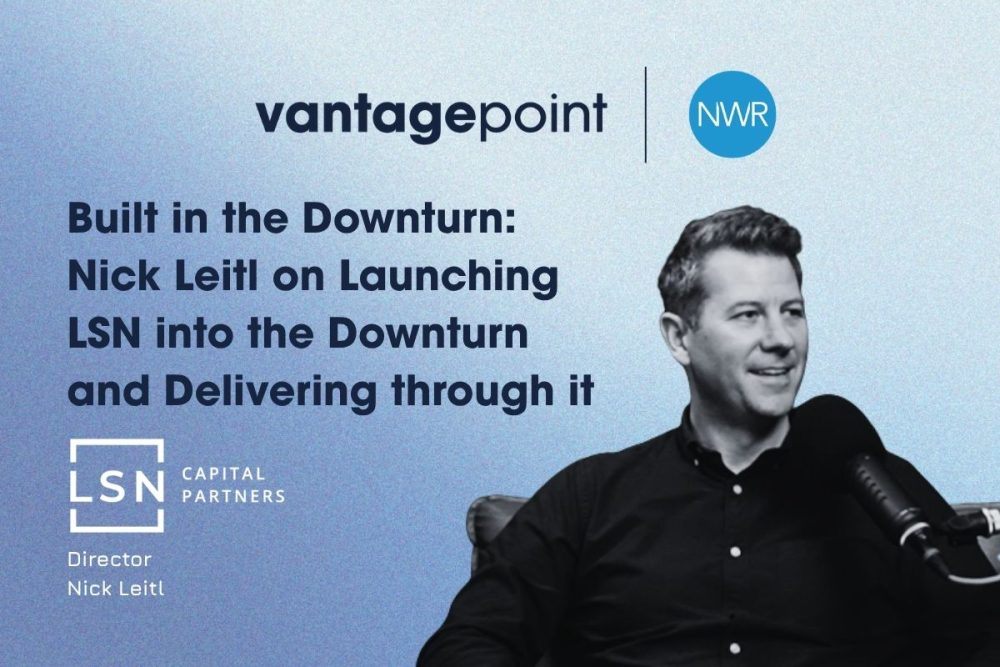
Built in the Downturn: Nick Leitl on Launching LSN into the Downturn and Delivering through it
Built in the Downturn: Nick Leitl on Launching LSN and Delivering Through It
LSN Capital Partners co-founder Nick Leitl explains what it took to launch a fund at the top of the market, why management quality sits at the centre of his process, and what a macro tailwind cannot fix.
LSN Capital Partners’ Vantage Point
- Nick Leitl is co-founder of LSN Capital Partners, an Australian small-cap fund manager he started with business partner Nick Sladen.
- He began in the mail room at Bankers Trust straight out of school, moved through Macquarie, then spent 16 years at K2 Asset Management, first as a dealer and then managing money.
- LSN launched in December 2021, close to the top of the market, and absorbed a sharp small-cap drawdown in its first six months.
- The first three years were deliberately spent building a track record and making the fund commercially viable, with distribution pushed after that and a distribution partner signed about six months before the recording.
- The process centres on management quality, close contact with the people running the businesses, and what Nick calls a 360-degree review of each one.
- The fund covers all sectors, including resources, and keeps capacity capped because performance suffers when a fund gets too large.
- Nick’s candid mistake was EROAD, where a compelling macro thematic could not overcome poor execution at the company level.
From the Mail Room to Managing Money
Simon Hinsley and Nick have known each other for about 25 years, and opened with a memory of an Oxfam Trailwalker that they agreed left a few scars but did not break them. Nick says his route into markets was a little different. He started in the mail room at Bankers Trust straight out of school, packaging up the daily research reports and delivering them to fund managers before their 7am meetings.
He got close to the team on the institutional desk, then moved to Macquarie on the retail broking side. His old boss from Bankers Trust started K2 Asset Management and called him a few years later to ask if he wanted to join. Nick started there as a dealer, then moved into funds management and spent more than ten years managing money, mostly in Australian small caps, meaning stocks outside the top 100.
What K2 Taught Him
Nick was the fifth employee at K2, and says the business grew into a team of more than 25 and produced a number of people who went on to start their own firms. He says he learned a great deal about managing money, managing risk and building a start-up funds management business.
Simon asked why K2 later shrank. Nick says businesses like that are either in growth mode or ex-growth mode, and taking them to a large scale takes a lot of work and succession planning. The founder’s success can cause distractions, and the staff were ambitious people who would eventually want to go and do their own thing. As Simon put it, K2 was almost a victim of its own success.
The great thing about K2 was it was very performance driven, and the founder gave you the space to go and invest and make mistakes. He was never gonna tell you what to do. You had to find your own process.
— Nick Leitl
Eighteen Months Out, and a Partner Who Thinks the Same Way
After leaving K2, Nick spent about 18 months out of the market during COVID, which he says felt like five years. He knew he wanted to do his own thing and spent the time working out what that looked like. He teamed up with Nick Sladen, who has been in markets and managing money for as long as he has and thinks about investing in the same way.
Simon asked whether sharing a mindset risks becoming an echo chamber. Nick says being on the same page is essential, but they are not identical, and seeing things slightly differently is a positive.
It’s like a marriage. Markets have tested us, and that’s the ultimate test of the relationship, when markets are drawing down and stocks aren’t working.
— Nick Leitl
Launching at the Top of the Market
LSN launched its fund in December 2021. Nick quotes Mike Tyson: everyone has a plan until they get punched in the face.
The timing was close to the peak of the zero-interest-rate market. Small caps fell sharply in the first six months, and Nick says three of those months were among the worst drawdown months in history. Simon pointed out the pressure of a start-up: young families, personal pride and a public scoreboard, with monthly reports and people watching closely in the early days.
Nick says he is grateful for the people who backed them early. The experience solidified the process, and investors who stayed with the fund through that period have since been rewarded.
Your pride’s on the line. Everything’s on the line, and you just do whatever it takes to make it work.
— Nick Leitl
Three Years to Build a Track Record, Then Distribution
Nick says the industry rule of thumb is a three-year track record for anyone who does not know you. LSN spent its first three years building that record and making the fund commercially viable, with daily pricing, platform listings, ratings and the rest of the structure.
After that, the focus moved to getting out there and pushing distribution. The firm signed a distribution partner about six months before the recording, and Nick says they have been very good. He stresses alignment: he and his partner are 50/50 owners of the business and investors in the fund, so the outcome of the performance dictates the outcome of their lives.
Managing the Stress
Asked how he manages stress with a young family, Nick says he is a lot better at it now than when he was a young investor. He focuses on the stocks he owns rather than the market, with confidence in the businesses and the people running them, and says regular contact with management helps filter out headlines. He points to the last couple of years of extraordinary volatility.
He says the family is in it too, whatever the business. His father-in-law started a manufacturing business from scratch with a desk, a pad and a pencil in the front room, and that is part of what motivates him. But he does not take it home, a skill he learned from K2’s founder, who was good at switching off and keeping a long-term focus.
Management Is the Whole Game
The theme Nick returns to most is management. He says the more time passes, the more important it becomes to understand who the people running a business are, how they operate and whether they will deliver when markets swing.
It’s all about execution really in the end. It’s all about management.
— Nick Leitl
LSN’s diligence goes well beyond the boardroom. The team sees management at conferences and social events, speaks to people who know them or used to work at the business, and runs what Nick calls a 360 review. He says it is amazing what snippets you pick up. Starting his own business, he adds, has made him appreciate the decision-making and control that management has over outcomes, and he thinks his own process and performance have improved as the fund has matured.
What Changed in the Process
Simon asked whether the team has become more reckless as it has become more comfortable. Nick compares it to a footballer missing a first shot. You are a bit more careful on the second, but now there is confidence in the process, and the team backs itself more rather than waiting another reporting period before entering a stock.
He says the process is always evolving. A clear improvement is position management, in how the team exits and enters stocks. It all comes back to understanding the business, knowing the management and having confidence in the earnings outlook and its sustainability.
The Pitch: Alignment, All Sectors and Capped Capacity
Asked what his edge is over the many other small-cap funds, Nick says people always want a secret formula, a metric on the balance sheet no one else is looking at. He does not claim one. His answer is a mix of things:
- Alignment: the founders are 50/50 owners and investors in the fund, with early backers coming from family, friends and close contacts, which adds to the onus to deliver.
- All sectors: the fund does not exclude any, including resources, which Nick says has been a hot space and where both founders have had success. Some funds cannot touch it.
- A tested process: in four and a half years it has been through 15 interest rate rises, a tariff meltdown and two wars.
- Capped capacity: both founders have run large funds before, and Nick says performance suffers when capacity gets too large.
Position sizing is part of the discipline too. Nick says the biggest positions are around 4 to 5%, not 10 or 12%, and that the fund has not relied on a single microcap to deliver half its performance. A valuation focus has helped navigate large drawdowns in overheated sectors, which means missing some upside when markets are hot but sleeping a little better at night.
Wins: Backing the Experts Early
Nick gives two examples of stocks that worked. He is careful to say these are examples, not recommendations. The first is Genus Plus, which has been the fund’s best performer. Nick invested in its IPO while at K2, and he made contact with the founder, Dave Richards, after starting LSN. The business is a high-voltage electrical engineering company, and Dave is an electrical engineer who owns about half of it.
The industry tailwind’s blowing, but his execution and his industry knowledge, and being totally invested, totally committed. He owns half the business.
— Nick Leitl
Nick says being early and off the radar helped, since no one covered it, but what mattered most was that the tailwind was backed up by execution. The second example is Megaport, which the fund bought more recently. LSN got the timing wrong at first, in the tech sell-off, but after a lot of work and many conversations with CEO Michael Reed, the team believed in its position as a beneficiary of AI and compute demand. Nick says a recent announcement validated that, and it is satisfying when management delivers.
The Miss: When a Thematic Isn’t Enough
Nick’s candid mistake is EROAD, a New Zealand telematics business that collects a road-user charge for the government on heavy trucks. The thematic looked compelling. Governments need revenue, electric vehicles bypass fuel tax, and road-user charging looked inevitable. EROAD held a dominant position in New Zealand and had ambitions in the US and Australia.
But execution fell short. Contracts expected in the US did not materialise, the cost base was heavy and cash flow was poor, leading to a downgrade and a heavy fall in the share price. Nick says LSN did not lose a lot of money on it, and sold half the position, met management, then moved on.
You’ve got macro tailwinds, industry tailwinds, and the bottom up doesn’t match up with the top down.
— Nick Leitl
He says this is the common trait of the stocks LSN gets wrong: a strong industry tailwind lifts the share price while, underneath, management is not executing. Managing losers is not just a performance question, he adds. A position of two or three per cent of the portfolio can take up half your head space, so getting the balance right matters.
Learning From Losers and Picking the Right Horse
Asked whether he learns more from winners or losers, Nick says losers. You analyse what you missed forensically, which does not stop you from getting others wrong but does make you more aware of where you can. He adds that patience is another lesson. Early on stocks are just stocks, but as you mature they are businesses, and businesses that continually deliver generally rerate.
On a theme like electrification, where there are six to eight ways to play it, Nick says LSN looks for the experts in their field. Genus Plus’s founder has been doing it for 20 years, and Duratec is founder-led and meticulous with its contracts, though contracts can blow up. The team is wary of businesses pivoting into a hot industry to chase a thematic.
More Than Performance: Brand and Trust
Simon noted that CEOs talk about balancing the business with investor relations, and asked how that looks for a fund manager. Nick says running money, running the business and raising money are all equally important. Strong returns are almost a necessity, but he wants LSN to be trusted for more than its numbers.
People just want that validation that these guys are real and good at what they do. They’re not taking undue risk. These guys aren’t risk-takers, they’re not rogues.
— Nick Leitl
He says that trust takes time to play out, and the firm is starting to see the benefit. Investors do the same checks on a fund that LSN does on a company, looking beyond the boardroom, with online searches, touch points and people who know the founders.
The Next Three to Five Years
Looking ahead, Nick says growing the team is part of the plan, with additional staff on the investment side as well as in the back office and operations. LSN has talked about capping the fund at a level based on its liquidity analysis of the stocks it owns, which Nick believes is the optimal size to keep generating strong performance while running a proper business.
Having third-party distribution also eases the workload, he says. It makes the team more efficient and targeted when it meets clients and potential clients, and lets the focus go back to running and managing the money. Simon closed by calling it a personal and professional journey, and wished Nick luck for the next three to five years.
This post is general information about the conversation only. It is not financial advice, and the stocks mentioned are examples discussed in the episode, not recommendations.