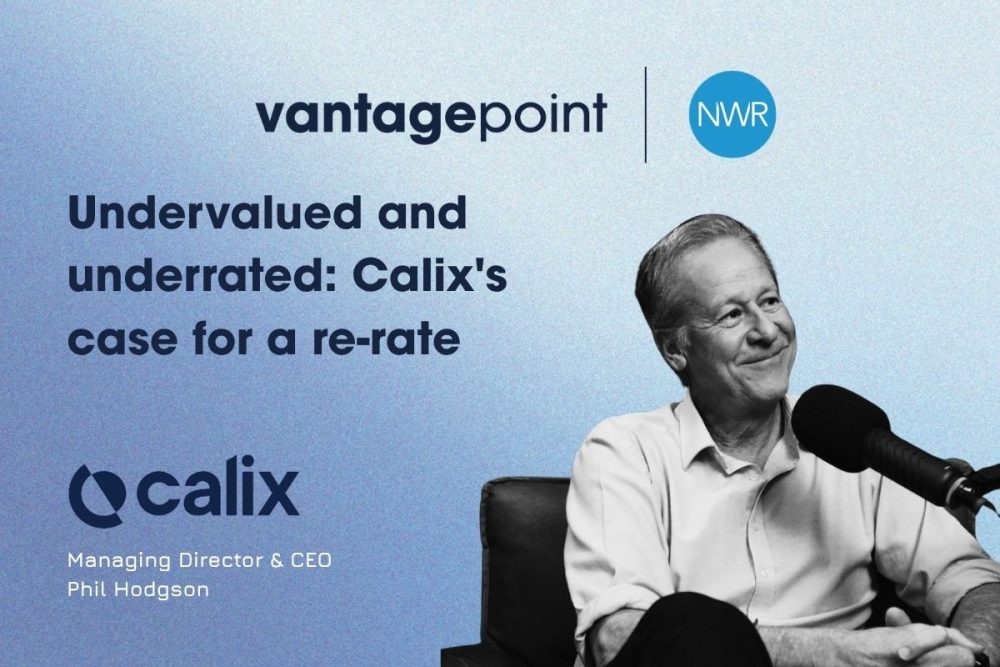
Undervalued and underrated: Calix’s case for a re-rate
Undervalued and Underrated: Calix’s Case for a Re-Rate
Calix CEO Phil Hodgson returns to Vantage Point to explain the reset after the clean tech boom, why the water treatment business is quietly working, and what is left before Zesty’s Kwinana project can reach a final investment decision.
Calix’s Vantage Point
- Calix (ASX: CXL) is in its eighth year as a listed company, having ridden the green boom into the ASX 300 before clean tech sentiment cooled and the market reset.
- Phil’s biggest regret is that Calix pivoted to a leaner, lower-cost model in late 2024 rather than late 2023.
- The US magnesium hydroxide water treatment business has reached critical mass, with fixed costs held steady while revenue grows, and Phil says there is a long runway of customers still to win.
- Zesty is Calix’s hydrogen-based iron-making technology, built around an externally heated kiln, and it has moved from lab to pilot to a planned demonstration plant at Kwinana.
- Rio Tinto took over the Kwinana site after its own in-house BioIron project stalled, and ARENA is also backing the project.
- A newly announced hydrogen supply partnership with Perdaman removes one of the key risks, and matching project financing is the last major piece left.
- Phil argues the market is treating Calix purely as a clean tech proxy and undervaluing its partnerships with Rio Tinto, Adani and Heidelberg, which he says have little to do with the carbon price.
From IPO to Green Boom to Reset
Calix listed eight years ago, and Phil says the years since have covered a full boom-and-bust cycle. It rode the wave of decarbonisation into the ASX 300, when many people felt decarbonisation was inevitable and would happen within the decade. Calix was still developing its technology and not yet profitable, so it used the moment to raise capital efficiently.
Then the winds shifted. Phil says the company underestimated the impact of the change of US administration. The US accounts for only a small share of global cement and steel production, but it carries outsized political weight. Interest rates, global conflicts and new themes like AI took attention from clean tech, and for a pre-profit company that meant future value was discounted heavily.
The Biggest Regret: A Year Too Late
Asked what he would do differently, Phil does not hesitate.
I think we probably pivoted too late to a lower cost model. We had a lot of irons in the fire and we should have pulled a few of those irons out a little bit earlier.
— Phil Hodgson
Calix made significant changes in late 2024, narrowing its focus to a few large opportunities while building a cash-generating business underneath them. That gave it security from the cash generators, with upside from the high-value applications of the technology.
The pivot to that strategy was late ’24. I wish I’d done it late ’23. And that’s my biggest regret.
— Phil Hodgson
The Magnesia Business: Bootstrapping a Technology Company
The strength of the company today rests on a business that started in 2013. When Phil joined, Calix had very little money left and was trying to finish its first kiln. It was not yet listed, so capital options were limited, and it needed something that generated revenue.
The answer was a small magnesite mine in South Australia at Myrtle Springs. Calix turned the mineral into magnesium oxide, mixed it with water and sold it to the water treatment industry as an alternative to caustic soda. It priced cheaply to take on a dominant player, and won enough market share to pay people and keep bootstrapping the rest of the company. Phil says that business is an important part of the foundation.
Buying Its Way Into the US
Around 2019, Calix looked at a US business, Inland Environmental Resources, which was roughly two and a half times the size of the Australian operation. Phil says it was making a pretty poor product but was very good at converting customers from caustic soda to magnesium hydroxide. Calix raised money after its IPO to take it over.
The US appealed for a second reason: the customers are five to ten times the size of Australian ones. The sales cycle is long, often several years of building trust and running trials, so bigger customers make that effort far more worthwhile.
Reaching Critical Mass
The US business has now passed what Phil calls its Rubicon. He says all it needed was critical mass, and the maths behind it is simple.
The cogs grows linearly with your revenue, but the fixed costs that sit above that, we’ve been able to hold pretty constant.
— Phil Hodgson
That means further revenue growth flows through to earnings, without substantial new costs. Calix signed a major US contract in December 2025, and Phil says there are at least a dozen accounts of that scale that it knows of, among large food and industrial processors. It estimates it has about 15% of the immediately addressable market of existing magnesium hydroxide users, with a far larger adjacent market of customers still on caustic.
Because Calix’s product is stable, unlike most other magnesium products, it can be trucked long distances. That allows a geographic expansion strategy, moving from the Pacific Northwest into the Midwest and then across the food belt. The sales cycle is long, but Phil says customers are very sticky once won.
A Very Different Company
Phil argues that the business is in the strongest position it has ever been in, and points to how much has changed since the IPO. Then, Calix had a small water business, a lime and cement play with no licence agreements, no thought of iron or aluminium, and it charged nothing for test work. Today it charges for test work and pre-work, because it has built enough plants and gathered enough data to credential itself.
On the partnership side, it now has:
- Rio Tinto: a joint development agreement with the world’s largest iron ore company.
- Heidelberg: a joint development and licence agreement in cement and lime, plus a currently paused project with a consortium that includes Cemex, Lafarge and Cimpor.
- Adani: a newly announced joint development arrangement with a top-ten global cement company.
Undervalued? The Clean Tech Proxy Problem
Simon put it to Phil that the market appears to place little or no value on the water business’s growth or on Zesty. Phil does not say the market is wrong.
One could argue perception is reality. In the end, we know we’ve gotta hit some proof points for value to be recognized.
— Phil Hodgson
His view is that the market sees Calix as a clean tech business whose fortunes are tied to how clean tech is viewed, and that Calix must do a better job of communicating advantages that have nothing to do with it. The Adani deal is his example.
The cement deal we just did with Adani has nothing to do with the price of CO2 today or a price of CO2 in India or anything like that.
— Phil Hodgson
He says it is about unlocking value in other ways: de-bottlenecking a cement plant and giving the customer energy flexibility. Those are big counterparties adopting the technology because it makes sense today, with clean tech as the cherry on top later. Simon adds that the business is also right-sized now, with a lower cost base and a healthier position than a couple of years ago.
Zesty in Plain English
Zesty came from Calix co-founder Mark Sceats, who filed the patent in 2021. Phil is quick to point out that he is not a scientist, but he explains it simply. The core technology across the group is a new type of kiln, essentially a large steel tube heated from the outside. For iron making, fine iron ore particles, anything smaller than about a third of a millimetre, fall through the tube.
The tube walls are heated to around 1,000 degrees Celsius and radiate heat into the falling particles. Hydrogen is introduced at the bottom.
Iron ore’s basically rust. Iron oxide. So if you can strip that oxygen off, then you’ve made iron.
— Phil Hodgson
The hydrogen strips the oxygen off the ore, and what comes out the top is steam. The tube never has to be built any bigger, since Calix has already built it at full scale. The progress has been quick: from patent to lab, to a 2,000-tonne-a-year pilot at Bacchus Marsh, to a completed front-end engineering design for a 30,000-tonne-a-year demonstration plant at Kwinana. Phil says independent observers have commented on how fast that was.
How Rio Tinto Came Aboard
Part of that speed was hustle. Calix stopped work on batteries and quickly converted one of its reactors that made battery materials into its first pilot-scale iron facility. It has since tested ores from Rio Tinto, BHP, Fortescue, Grange and Roy Hill, which caught the interest of all of them. Rio moved fastest.
Rio had been developing its own in-house technology, BioIron, which mixes iron ore with biomass and uses microwaves. The plant it planned for Kwinana ran into cost blowouts, and Rio did not believe it could reach an economic solution in the time and with the money it was willing to spend.
It just so happened that we were there engaging heavily on our technology at the same time they were considering what the future of BioIron should be.
— Phil Hodgson
The result was a neat swap. Calix moved into the Kwinana site in November last year, while BioIron went back into Rio’s R&D phase without being killed off.
The Last Boxes Before a Final Investment Decision
Several pieces are needed before the Kwinana project reaches a final investment decision. ARENA announced funding support in July last year for the full-scale tube, and typically funds about half of a project’s cost. Rio is contributing in cash and in kind, and both have done extensive technical due diligence. That, Phil says, is why technology risk is not a significant concern. What remains is the matching financing.
The final piece to fall into place, last week, was hydrogen. Many people assumed it would be easy, but the numbers say otherwise.
There’s one ton of hydrogen in that tanker, in that whole huge tanker. We’d need 5 tankers a day to run our demonstration facility.
— Phil Hodgson
The original plan was to pipe hydrogen over the fence from the hubs being developed under ARENA. Nearly all of those hubs have fallen over, with one in Newcastle still moving ahead. Hydrogen went from a low-risk assumption to a key enabler or disabler of the project. Calix has now announced a partnership with Perdaman, which is developing hydrogen production for its urea plant on the Barrow Peninsula, giving Calix a strong procurement and project management partner.
To reach final investment decision readiness, Calix also needs its capital costs sorted within a range and its utilities secured. Phil says those project risks are now manageable and are largely within Calix’s control. The financing is being sought at the subsidiary level, and impact funds typically want someone else to have led the technical due diligence first, which ARENA and Rio have done. He says feedback from potential investors has told the team what they want to see, so they are not starting from a standing start.
Still in It After 13 Years
Phil has been with Calix since early 2013, and the company nearly went under in 2014. Management and staff are substantial shareholders, and most put their own money in. Asked whether the drive is still there, he says it has only grown. He uses an analogy from his days at Shell.
I equate it to something like first class. I’ve flown economy for 13 years. You get a taste and you want to get back there.
— Phil Hodgson
His plan is to make that more sustainable: keep growing the magnesium business, and be ready to deploy plants when clean tech becomes important again, from a far stronger base than before.
No lessening of the passion. Only more of it, because we can taste it. It’s that close.
— Phil Hodgson